
State.io — Conquer the World
CASUAL AZUR GAMESStrategy
4.120.26K Reviews
- Version
- 4.5.1
- Installs
- 100.00M
- Age Rating
- Everyone
Screenshots

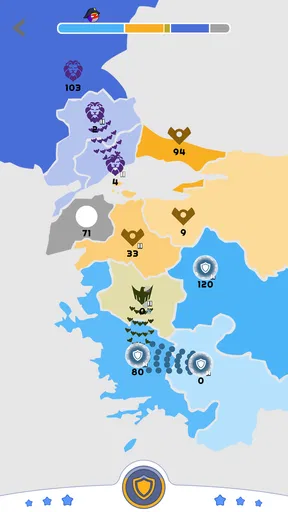






Our Review of State.io — Conquer the World
 Analysis by Appyee
I went into State.io — Conquer the World expecting a quick territory game, and that is exactly where it makes the strongest impression. It turns strategy into short decisions: choose where to send your forces, react to changing borders, and try to take control before the map gets away from you. The presentation is simple enough to understand immediately, but the timing of each move gives the matches more tension than the minimalist style first suggests.
This is a free strategy game from CASUAL AZUR GAMES, available for everyone and suitable for players who want something lighter than a traditional grand strategy title. It has reached over 100 million installs and holds a 4.1 average from around 658 thousand ratings, which fits my experience: it is easy to start, quick to replay, and broad enough to attract people who would not normally spend time with complicated war games. Still, its simplicity comes with limits, and those limits matter once the first few matches stop feeling new.
How the basic workflow feels in real play
I find the basic loop easiest to follow when I treat each turn as a quick map-reading task rather than a race to tap first. This section looks at how choosing a target, checking nearby pressure, and adjusting after a move shape the feel of play. It also leads into the practical question of how comfortably that rapid, touch-driven rhythm works for different players.
Read the map before sending anything
The most useful habit is also the easiest to overlook: I pause mentally before making the opening move. The game invites quick reactions, but sending units immediately is not always the best choice. I first look at nearby neutral areas, the position of opponents, and whether expanding in one direction would leave another border exposed. That small scan turns the opening from random tapping into a repeatable routine.
My usual workflow is to secure a manageable area, watch which opponent is becoming the most immediate threat, and then decide whether expansion or defense deserves priority. This is more reliable than trying to attack every available state. A large territory can look impressive while being difficult to protect, especially when its edges create several possible entry points for rivals.
The game works particularly well in short breaks because a match does not require the long preparation associated with heavier strategy games. I can play while waiting for transport or during a brief pause, then return to another round without needing to remember a complicated technology tree, diplomatic relationship, or resource economy. That accessibility is the central appeal, not a side benefit.
Why quick reactions still need restraint
The store summary emphasizes reacting quickly, and the game does reward attention, but speed alone is not a strategy. I had better results when I treated each move as a choice between gaining space now and preserving options later. If I expand too aggressively, I may create a thin front that looks powerful but collapses under pressure. If I wait too long, opponents can surround the areas I wanted.
That creates a useful rhythm: make a clear move, observe the result, and avoid immediately correcting it with several rushed commands. Experienced play is less about tapping constantly and more about recognizing when the current position has changed enough to justify a new plan. The interface is approachable, but the player still has to supply the discipline.
A realistic everyday session
Imagine opening the game during a ten-minute coffee break. I would not try to force a perfect campaign or learn every system in one sitting. Instead, I would play one round with a specific goal, such as practicing controlled expansion or protecting a narrow border. If the match ends quickly, I can start again without a large time commitment. If I lose, the result is still useful because the map shows where impatience or poor positioning created the problem.
That format makes the game a better fit for casual sessions than for players seeking a deep, uninterrupted strategy experience. It is also why I would recommend it to someone who enjoys the idea of conquest games but finds traditional entries too demanding. The decisions arrive quickly, and the cost of experimenting is low.
Settings and habits worth checking
Before settling into longer sessions, I would check the available in-game settings and make the controls comfortable for the device. In a game built around quick selections, accidental taps and awkward screen handling can be more frustrating than a bad strategic decision. I also prefer playing with notifications and distractions reduced, because the value of a fast reaction disappears if my attention is divided.
I would not expect settings to transform the game into a different experience. Their practical role is to remove friction: make sure the display is easy to read, the sound is appropriate for the situation, and the touch controls feel predictable. That matters more here than decorative customization. When every move depends on seeing the map clearly, a comfortable setup supports better decisions.
Another useful habit is to avoid treating a replay as a completely fresh event. After a loss, I try to identify one specific mistake: expanding too far, ignoring a threatening border, or spending attention on a low-value target. Changing one behavior in the next round gives the game a learning loop. Restarting without reflection can make the matches feel repetitive, while a small personal challenge keeps them purposeful.
Faster patterns that improve consistency
The first pattern I recommend is controlled growth. Rather than grabbing every open area, I choose expansion that improves the shape of my position. A connected territory is generally easier for me to understand and defend than a scattered collection of isolated gains. This does not guarantee success, but it reduces the number of situations that require emergency reactions.
The second pattern is to watch borders instead of staring only at the largest visible territory. The most dangerous opponent is not always the one with the most land. A rival positioned next to several of my weak points can cause more trouble than a distant leader. I therefore check the edges of my territory after every meaningful change, especially when an opponent begins moving toward an area I had considered safe.
The third pattern is to preserve flexibility. I try not to commit every available advantage to one direction unless the payoff is clear. Keeping room to answer a sudden attack is often more valuable than making a dramatic but uncertain push. This is where the game becomes more interesting than a simple race for territory: the best move is sometimes the one that prevents a bad future position.
These habits also make the game easier to compare with familiar alternatives. A board-game-style strategy title may offer deeper planning, more formal rules, and longer campaigns, but it demands more time and concentration. A real-time tactics game may provide richer unit choices, yet it can feel overwhelming on a phone. State.io sits between those extremes. It gives me the satisfaction of reading a map and making positional choices without requiring a full evening.
Where the simple design helps
The clean presentation keeps the central question visible: where should my forces go next? I do not have to spend much time learning menus before understanding the objective. That makes the game approachable for younger players and for adults who want a casual strategy break. Its Everyone content rating also reflects that accessible positioning.
The simplicity is especially helpful when introducing the game to a friend. I can explain the basic idea quickly, then let the person learn by playing rather than studying instructions. The first few rounds communicate the important relationship between expansion, pressure, and defense naturally. That immediate readability is one of the title’s strongest qualities.
At the same time, the uncluttered design should not be mistaken for endless depth. There are fewer layers to explore than in a full-scale empire simulator. Players who enjoy diplomacy, detailed economies, complex armies, or long-term technological planning may find the experience too narrow. The game focuses on map control and reaction, and it stays focused there.
Advanced limits and points of friction
My main reservation is replay depth. The short-match structure encourages repeated attempts, but repetition can expose the limited range of decisions. Once I understand the basic expansion patterns, some rounds begin to feel like variations on a familiar puzzle rather than a campaign that keeps unfolding. That is not a flaw for occasional play, but it can become noticeable for anyone seeking a main strategy game.
The free entry point is convenient, yet in-app purchases range from $0.49 to $24.99 per item. I would approach those purchases carefully and decide first whether the core loop itself remains enjoyable without spending. A low-cost game can still become expensive if impulse purchases are made simply to speed up frustration or chase a better result. For me, the sensible approach is to treat the free version as the test and only consider optional spending after I know I will return regularly.
Another limitation is that quick reactions can sometimes make a loss feel less informative than it should. When a position changes rapidly, it is easy to blame timing when the real problem was earlier: an exposed border, an overextended attack, or an expansion that created too many responsibilities. I get more value from the game when I review the sequence of decisions rather than judging the final defeat alone.
The current version is 4.3.0, and the game supports devices running Android 7.1 or later. That makes it accessible to many older phones, although the actual comfort of play will still depend on screen size, touch accuracy, and how smoothly the device handles the game. On a small display, map reading can feel less comfortable, so I would favor a device where neighboring territories are easy to distinguish.
Who should play it, and who should skip it
I would recommend it to casual players who like territory control, quick tactical choices, and repeatable matches. It is a good introduction to strategy for someone who does not want a dense rulebook. It also suits players who enjoy setting small goals: survive longer, expand more carefully, or stop reacting emotionally after an unexpected attack.
I would be more cautious recommending it to someone who wants a deep historical strategy simulation, a rich multiplayer ecosystem, or a long narrative campaign. Those players may be happier with a more complex alternative, even if that means spending more time learning the systems. State.io is not trying to replace those games; its appeal comes from being much easier to pick up.
It is also not the right choice if you dislike repeated short rounds or become frustrated by simplified strategic control. The game asks you to make meaningful choices, but it does not provide the enormous range of tools found in larger strategy productions. Knowing that boundary helps set the right expectation before downloading it.
My approach to improving at the game
If I were teaching a new player, I would suggest three practice rounds with three different priorities. In the first, focus only on reading the map before moving. In the second, practice keeping the territory connected and avoiding unnecessary fronts. In the third, deliberately hold back from an attractive expansion and see whether preserving a defensive option produces a better position.
I would also recommend changing only one habit at a time. Trying to become faster, more aggressive, and more defensive simultaneously makes it difficult to understand what actually worked. The game is better suited to small experiments than to a rigid opening guide, because the useful decision depends on the shape of the current map and the pressure from nearby opponents.
One subtle trade-off is that defensive play can feel less satisfying even when it is strategically sound. Taking land gives immediate visual feedback, while waiting preserves potential rather than showing progress. I have found that recognizing this emotional pull improves my decisions. If I attack only because the opportunity looks exciting, I may be solving the feeling of inactivity instead of solving the map.
Overall verdict after repeated sessions
State.io — Conquer the World succeeds as a compact strategy game with a clear purpose. It gives me quick map-control decisions, enough tension to make each round engaging, and a low barrier to entry that works well on mobile. The best experience comes from combining fast observation with restraint: check the borders, choose connected gains, and keep an answer available when the situation changes.
Its weaknesses are equally clear. The streamlined design limits long-term depth, repeated rounds can become familiar, and optional purchases deserve a measured approach. Players looking for a full strategic sandbox should choose something more elaborate. Players wanting a readable conquest game for short sessions, however, will find a lot to like.
With a 4.1 average and more than 100 million installs, its broad appeal is understandable, but popularity is not the reason I would suggest it. I recommend it because the core loop is easy to grasp while still rewarding better habits over random tapping. It is at its best when you treat each quick match as a small lesson in positioning, timing, and controlled risk. For that specific kind of mobile strategy session, CASUAL AZUR GAMES has made a focused and enjoyable option.
Privacy and Permissions
See what permissions an app requests and how it handles your data.
- Wi-Fi connection information
- view Wi-Fi connections
- Other
- view network connections, full network access, control vibration, prevent device from sleeping, Google Play license check
Verdict
Strengths of State.io — Conquer the World
- Simple controls make it easy to start playing immediately.
- Short matches fit well into quick gaming sessions.
- The world map gives each level a clear sense of progress.
- Different territories create varied tactical challenges.
- Runs smoothly on most modern Android and iOS devices.
Limitations of State.io — Conquer the World
- Later levels can feel repetitive after the core strategy becomes familiar.
- Some upgrades and content may require watching frequent ads.
- Mistakes are costly when enemy territories expand quickly.
- The game offers limited strategic depth for experienced players.
- An internet connection may be needed for certain features or ads.
Other Releases by CASUAL AZUR GAMES
View All
Worms Zone .io - Hungry Snake
Action4.3

Stack Ball - Crash Platforms
Arcade4.5

STAR: Super Tricky Amazing Run
Arcade4.2

Color Fill 3D
Puzzle4.6
Similar Picks in This Category
View All
Clash of Clans
Supercell4.5

Plants vs. Zombies™
ELECTRONIC ARTS3.7

Lords Mobile: Kingdom Wars
IGG.COM4.5

Clash Royale
Supercell4.4

Car Driving School : Car Games
Spark Game Studios3.9

Castle Clash: World Ruler
IGG.COM4.4
Frequently Asked Questions
What is State.io — Conquer the World?
State.io — Conquer the World is a casual real-time strategy game in which you expand your territory by sending troops between connected states. The objective is to capture neutral and enemy regions, manage your available forces, and control the map before your opponents do. Its simple controls make it easy to start, while later levels require faster decisions and better timing.
How do you play State.io — Conquer the World?
Gameplay is based on tapping or dragging from one state to another to move troops. You must decide whether to attack an opponent, reinforce a vulnerable territory, or capture an unoccupied area. Each state generates units over time, so successful play depends on balancing expansion with defense. Watching enemy movements and choosing the right moment to strike is especially important.
Is State.io — Conquer the World free to download and play?
State.io — Conquer the World can generally be downloaded and played for free, allowing users to access its core levels without an upfront purchase. However, the game may include advertising and optional in-app purchases. These purchases can provide convenience or remove ads, but they are not normally required to understand the mechanics or complete the early stages.
Does State.io — Conquer the World require an internet connection?
Some parts of State.io — Conquer the World may be playable without a constant internet connection, which is useful when traveling or when mobile data is unavailable. Nevertheless, the availability of ads, updates, synchronization, and certain online features can depend on connectivity. For the most reliable experience, it is best to launch the game with a stable internet connection.
Is State.io — Conquer the World suitable for children and casual players?
The game is easy to learn because it uses straightforward gestures and a clear map-based interface, making it suitable for casual players who enjoy short strategy sessions. It contains fictional territory battles rather than realistic violence, but parents should still review the age rating, advertisements, and optional purchases. Difficulty increases over time, so younger players may occasionally need assistance.
Play our best games!


